How refrigerated LTL works
LTL stands for less than truckload. A carrier picks up pallets from several shippers, brings them to a terminal, sorts them by destination and loads them onto a trailer with other freight going the same way. Near the destination, the pallets are often sorted again onto a local delivery truck.
Each shipper pays for the space used, so the cost per pallet is low. The carrier sets the schedule around its network, with fixed pickup days on many lanes. The trailer runs at one temperature, or at a few zones split by bulkheads, chosen to suit everything on board.
How dedicated refrigerated shipping works
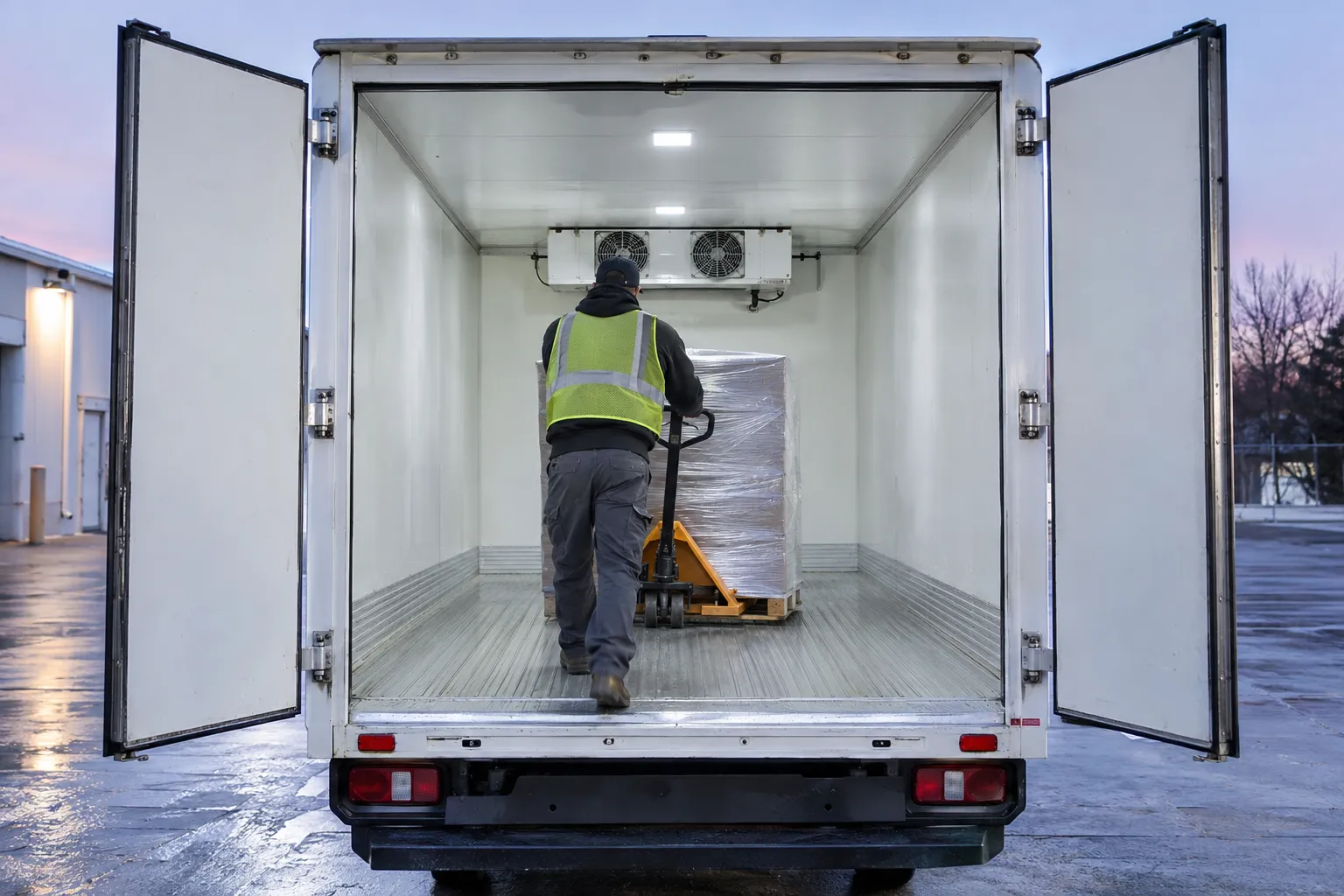
A dedicated truck is booked by one shipper for one trip. The driver loads your freight, sets the refrigeration unit to the temperature you give, and drives to the receiver. Nothing else is picked up on the way, and the freight stays on the same truck until it is delivered.
You pay for the whole vehicle and driver, including space you do not fill. In return you choose the pickup day, the delivery appointment and the setpoint. Smaller dedicated vehicles such as vans and box trucks keep that cost in proportion when the load is only a few pallets.
Dedicated and LTL compared
| Refrigerated LTL | Dedicated truck | |
|---|---|---|
| Who shares the truck | Several shippers | Only you |
| Transfers | Usually one or more at terminals | None; the same truck from pickup to delivery |
| Schedule control | The carrier’s network and set pickup days | Your pickup day and delivery appointment |
| Temperature control | One setting or zone shared with other freight | Set to the temperature your product needs |
| Typical cost per pallet | Lower | Higher |
| Best for | Hardy, flexible freight where cost matters most | Sensitive, urgent or high-value freight |
When LTL is the right choice
LTL is a sound way to ship a great deal of refrigerated freight, and for many loads it is the better choice. A dedicated truck would cost more without adding anything you need. Consider LTL first when these describe your shipment:
- The product is hardy and well packed, such as boxed frozen goods.
- The delivery date has some give.
- The product’s temperature matches a common LTL setting.
- You ship one or two pallets on a regular lane the carrier already runs.
- Freight cost is the main concern.
How to decide for your load
The case for a dedicated truck grows as the freight gets more sensitive or the timing gets tighter. Each terminal transfer is a chance for a pallet to wait on a dock, be handled roughly or sit beside freight that needs a different temperature. A short shelf life, a narrow temperature range or a fixed delivery appointment are the usual reasons shippers pay for their own truck.
List what the product can tolerate
Write down the temperature range, the shelf life and how much handling the packaging can take.
Fix the schedule
Decide whether the delivery date is firm or flexible, and whether the receiver works by appointment only.
Compare both quotes
Ask for an LTL quote and a dedicated quote on the same load. Set the difference beside the value of the product and the cost of a rejected delivery.
Where Benefit Transportation fits
Benefit Transportation does the dedicated side only. We do not run shared or consolidated LTL, and we do not run 53 ft trailers. We send a refrigerated van for one to three pallets or a 16 ft box truck for four to six, with a driver, anywhere in the lower 48 states.
That makes a dedicated truck practical for loads that are too small for a full trailer and too sensitive for a terminal network. If LTL fits your load better, use it. If the load needs its own truck, call or text David at (619) 839-9809.
Dedicated refrigerated freightRefrigerated LTL alternativeGet a quote
Common questions
What does LTL mean in refrigerated shipping?
LTL means less than truckload. Your pallets share a refrigerated trailer with freight from other shippers, and you pay for the space you use. The freight usually moves through one or more terminals between pickup and delivery.
Is dedicated refrigerated shipping faster than LTL?
It is usually more direct, because the truck goes from pickup to delivery without terminal stops or other shippers’ freight. Timing still depends on the distance and the dates, so ask about it when you request a quote.
Is LTL safe for temperature-sensitive freight?
It can be, for hardy products that match the trailer’s temperature. The risk rises with each terminal transfer and with product that needs a narrow range. Ask the LTL carrier what the trailer will be set to and how many times the freight is handled.
How many pallets do I need for a dedicated reefer truck?
There is no minimum. A dedicated truck can carry a single pallet. With Benefit Transportation, one to three pallets ride in a refrigerated van and four to six in a 16 ft box truck, so the vehicle is matched to the load.
Does Benefit Transportation offer refrigerated LTL?
No. Every truck carries one shipper’s freight, with no shared trailers, terminals or cross-docking. For small loads that would otherwise go LTL, a dedicated van or box truck is the alternative we offer. Call or text David at (619) 839-9809 for a quote.