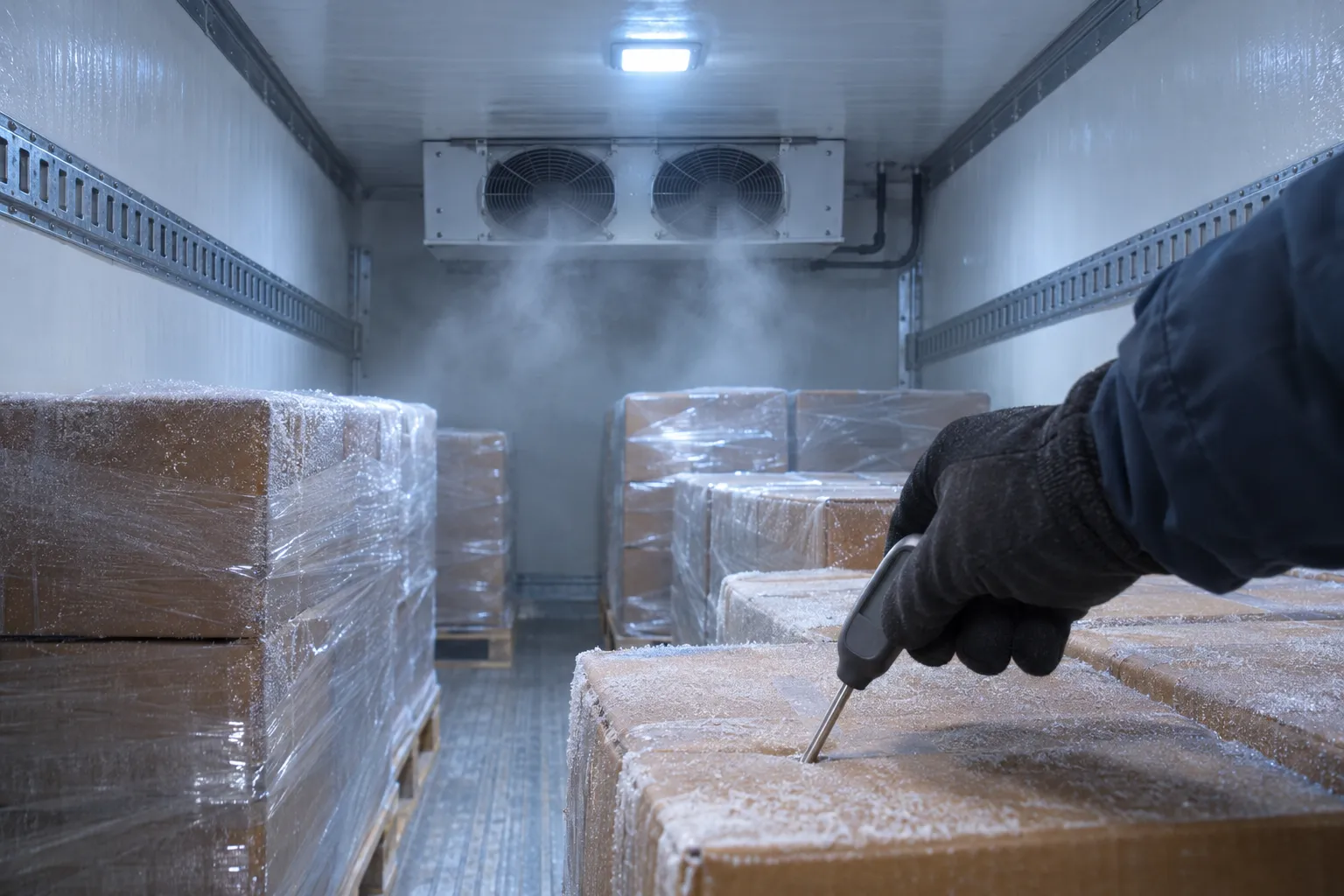
Who ships frozen food by the pallet
Frozen meal brands sending a first order to a regional distributor. Ice cream makers supplying shops outside their own delivery area. Bakeries shipping frozen dough, par-baked bread or finished cakes to a food service customer. Co-packers moving a short production run. Each of these has a few pallets that must stay hard frozen the whole way and cannot sit on a dock.
Frozen food temperature ranges
The general rule for frozen food is 0°F or below, measured in the product as well as in the air. Ice cream needs more. It softens and forms ice crystals well before it melts, so most makers ask for −10°F or colder. Use the table as general guidance and give us the setpoint on your spec sheet.
| Product | Typical setpoint | Why |
|---|---|---|
| Frozen meals and vegetables | 0°F or below | Keeps texture and stops partial thaw |
| Frozen bakery and dough | 0°F or below | Dough can start to proof if it warms |
| Frozen meat and seafood | 0°F to −10°F | Limits surface thaw and drip |
| Ice cream and frozen desserts | −10°F to −20°F | Prevents softening and ice crystals |
Why door openings and transfers matter
Frozen freight warms from the outside in. Each time the doors open, cold air falls out and warm, humid air takes its place. The cartons nearest the door soften first, then refreeze once the unit catches up. That cycle is what leaves frost inside the bag, ice crystals in ice cream and vegetables frozen into a block.
- Shared routes open the doors at every other shipper’s stop.
- A terminal transfer puts your pallets on a dock while they wait for the next trailer.
- Multi-temperature trailers rely on a bulkhead between frozen and chilled freight.
- Dry freight packed with gel packs or dry ice has a limit that a delay can outlast.
- Product that has thawed and refrozen may be refused at the receiving dock.
Pre-cooling the box before loading
A refrigeration unit is built to hold a temperature. It is slow at pulling heat out of warm product or a warm box. Tell us the setpoint when you book so the box can be brought down before it backs up to your dock. Load product that is already at temperature, straight from the freezer, and keep the doors open for as short a time as you can.
How a dedicated truck handles frozen loads
Our vans and box trucks are Ford Transits with Thermo King units that hold from −20°F up to ambient. One shipper’s freight goes on each truck, so the doors open twice: once at your dock and once at the receiver’s. There is no cross-dock in the middle and no second trailer.
Refrigerated box truckExpedited refrigerated freightPrepare a refrigerated shipment
What to send for a frozen freight quote
- The product and how it is packed
- The setpoint, and whether any of the load is ice cream
- Pallet count and total weight
- Pickup and delivery ZIP codes
- The ready date and the receiver’s delivery window
Call or text David at (619) 839-9809 with those details, or send them through the quote form.
Common questions
What temperature does frozen food need in transit?
Frozen food generally travels at 0°F or below. Ice cream and some frozen desserts need colder, often −10°F to −20°F. These are general figures. Your product spec or your buyer’s receiving standard is what counts, so tell us that number when you ask for a quote.
Can you ship ice cream long distance?
Yes. Our trucks hold down to −20°F, which covers the range most ice cream makers ask for. The load rides alone with no terminal transfers, so the doors stay shut between your dock and the receiver. We deliver anywhere in the lower 48 states.
Is frozen LTL safe for a few pallets?
It can work, but it carries more risk than a dedicated truck. Frozen LTL moves through terminals and shares a trailer, so your pallets see more door openings and more handling. With one to six pallets, a dedicated van or box truck avoids both.
Do I need to pre-cool the truck before loading frozen food?
Yes, the box should be at the setpoint before product goes in. A reefer unit holds temperature well but pulls heat out slowly. Give us your setpoint when you book, and load product straight from the freezer so it starts the trip cold.
How many pallets of frozen food can you carry?
One to six pallets per load. The refrigerated van takes 1 to 3 pallets up to about 1,500 lb. The 16 ft refrigerated box truck takes 4 to 6 pallets up to about 3,500 lb. Frozen product is dense, so check the weight as well as the pallet count.