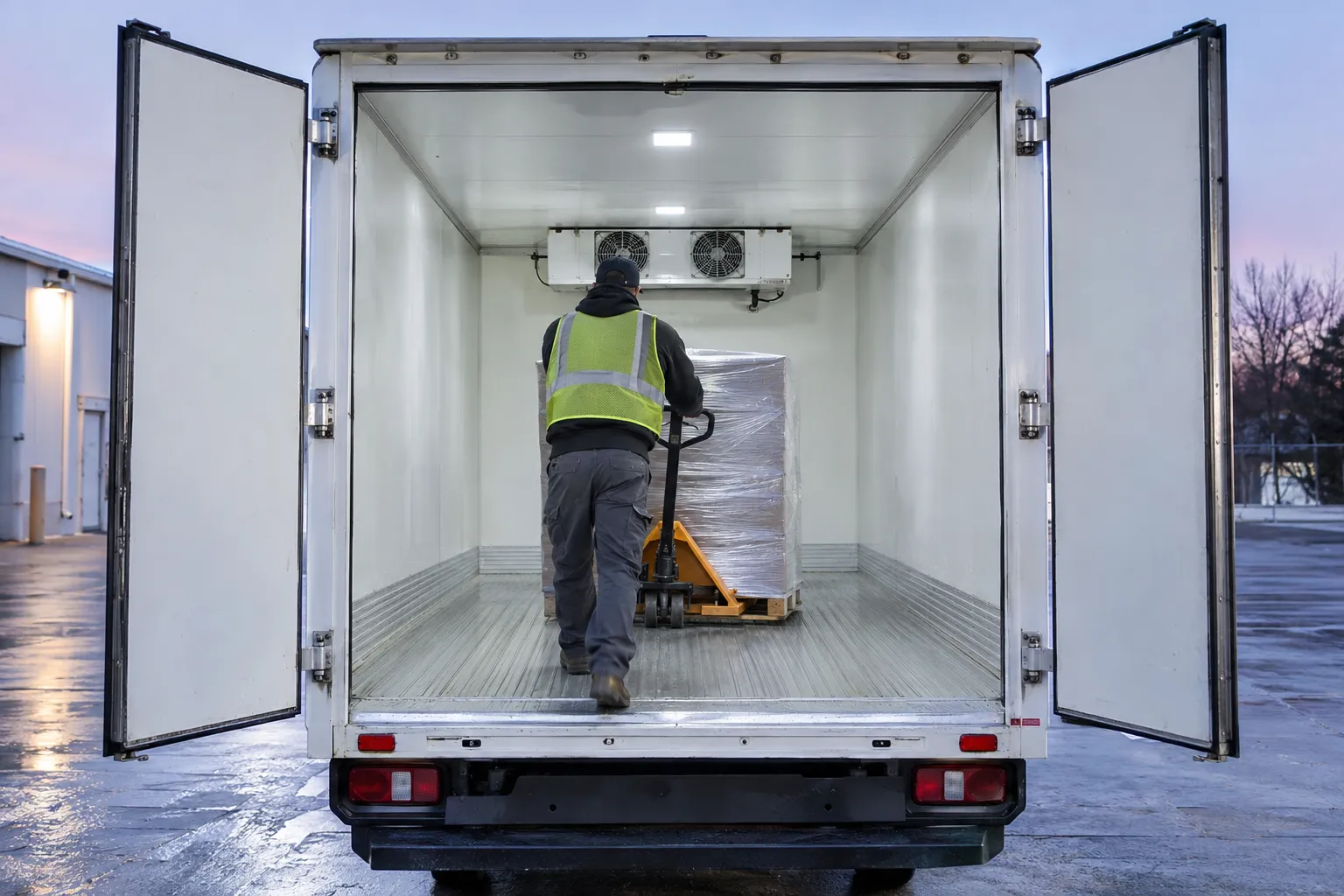
Who ships meat and seafood in small loads
Small processors and butchers sending boxed beef, pork or lamb to a restaurant group. Poultry and specialty meat producers filling an order for a retailer. Seafood wholesalers and importers moving fresh fish, shellfish or frozen product inland. Ranches selling direct that need a few pallets taken to a cold store in another state. The order is small, the product is valuable and it has a date on it.
Fresh and frozen temperature ranges
Fresh meat and fish are carried close to freezing without being frozen, because every degree above that shortens shelf life. Frozen product is held at 0°F or below. These figures are general trade guidance. Your plant, your buyer or your label sets the real number, so give us the temperature your product needs.
| Product | Fresh | Frozen |
|---|---|---|
| Beef, pork and lamb | 28–34°F | 0°F or below |
| Poultry | 28–34°F | 0°F or below |
| Fish fillets and whole fish | 30–34°F, often on ice | 0°F to −10°F |
| Shellfish | 35–45°F when live | 0°F to −10°F |
Keeping species and products separate
Some shippers and buyers require that certain products do not share a truck: raw poultry away from other meat, seafood away from anything that picks up odor, or one customer’s lot kept apart from another’s. The truck carries only your freight, so you decide what goes on it and how it is arranged. Tell us about any separation rule when you ask for a quote.
What goes wrong in shared or dry freight
- A shared trailer puts your product next to freight you did not choose.
- Seafood odor and meat purge can reach other cargo, and theirs can reach yours.
- Terminal transfers use up time on product with a short shelf life.
- Fresh fish on ice loses that ice faster each time a door opens.
- An insulated box in a dry van only lasts as long as its ice.
Receivers check temperature at the door, and warm product is commonly refused.
Short shelf life and direct runs
Fresh meat and seafood lose sellable days while they travel. A direct run uses fewer of them. The truck loads at your dock, drives the lane and unloads at the receiver, with no terminal and no stops for other shippers. If the date is tight, ask about an expedited load. For frozen product, the same direct run keeps the doors shut from pickup to delivery.
Dedicated refrigerated freightExpedited refrigerated freightRefrigerated van
How to get a meat or seafood quote
Describe the product
Tell us the species, whether it is fresh or frozen, how it is packed and whether it travels on ice.
State the temperature
Give the setpoint from your spec sheet or your buyer’s receiving standard, plus any separation rule.
Give size and lane
Pallet count, total weight, pickup and delivery ZIP codes, and the dates on both ends.
Get a quote
Call or text David at (619) 839-9809, or send the details through the quote form.
Common questions
What temperature is fresh meat shipped at?
Fresh meat usually ships between 28 and 34°F, cold enough to slow spoilage without freezing the product hard. Frozen meat ships at 0°F or below. These are general figures, and your plant or buyer may specify something tighter, so tell us the temperature you need.
How do you ship fresh seafood by truck?
Fresh seafood rides in a refrigerated box set near 30 to 34°F, often packed on ice or gel packs inside the cartons. On our trucks it travels alone and goes direct to the receiver. Tell us if the load is packed on ice so we know to expect meltwater.
Can fresh and frozen product ship on the same truck?
No, they should go on separate trucks. Each truck holds one temperature, so fresh product would freeze at a frozen setpoint and frozen product would thaw at a chilled one. If you have both, ask us to quote two trucks.
Can you keep seafood separate from meat?
Yes. Every truck carries one shipper’s freight, so nothing is loaded with yours unless you put it there. If your buyer requires species or products to travel apart, tell us when you ask for a quote and we can price separate trucks.
Do you offer refrigerated seafood shipping nationwide?
Yes. We pick up and deliver in all of the lower 48 states with refrigerated vans for 1 to 3 pallets and 16 ft box trucks for 4 to 6 pallets. Each load is dedicated and runs direct, which suits product with a short shelf life.