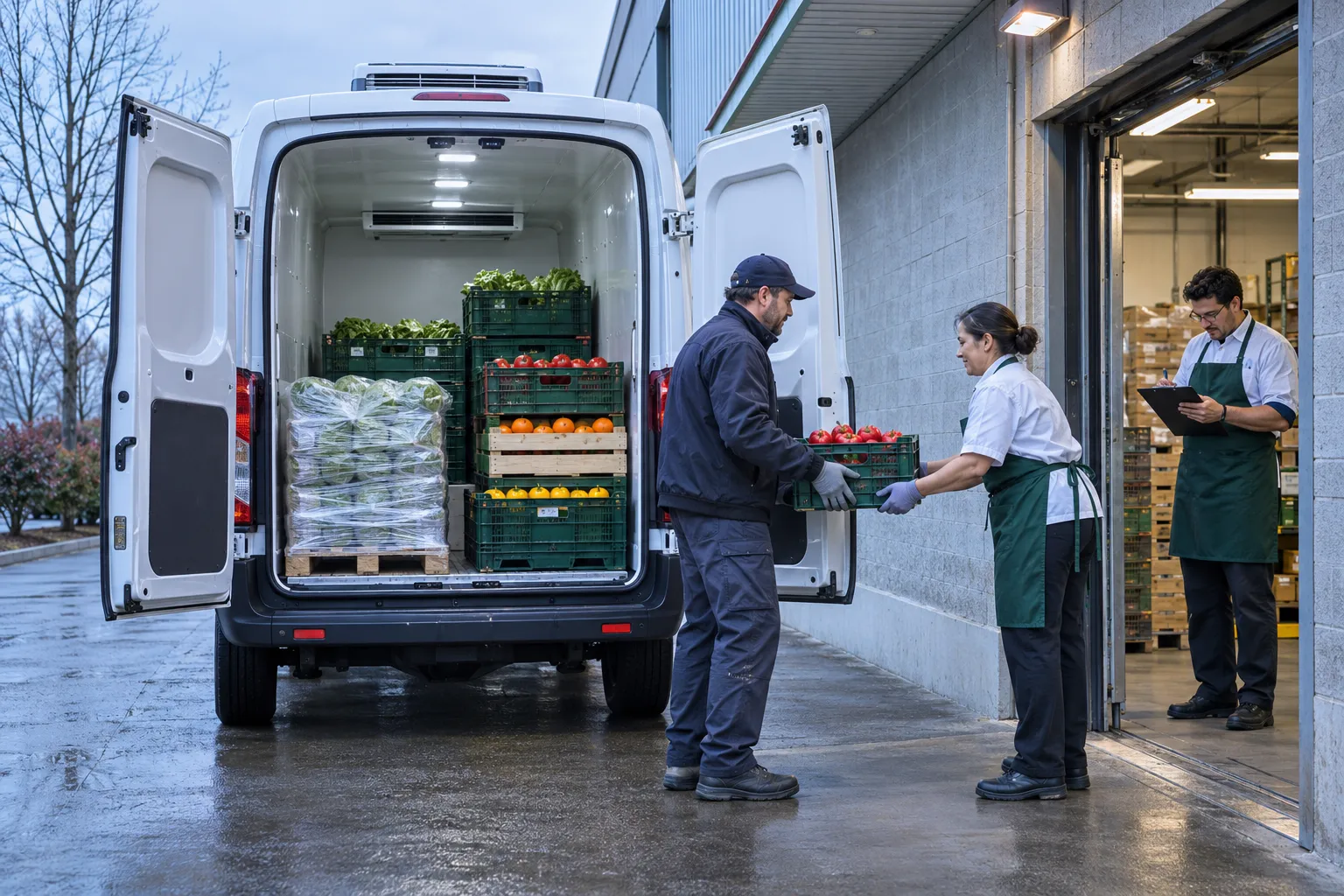
Who ships produce in small loads
Growers sending a few pallets to a buyer in another state, packers filling a short order, wholesalers restocking a restaurant supplier, and specialty importers moving a first lot to a new market. These loads are too small for a 53-foot trailer and too perishable to wait at a terminal. A van takes 1–3 pallets and the box truck takes 4–6.
Typical holding temperatures for fresh produce
Most fresh produce travels between 33 and 40°F, but the right number depends on the commodity. Some crops are damaged by cold well above freezing, which is called chilling injury. The figures below are general trade guidance. Your packer or buyer sets the real requirement, so give us the temperature your product needs.
| Commodity group | Examples | Typical range |
|---|---|---|
| Cold-tolerant | Leafy greens, broccoli, berries, apples, grapes | 32–36°F |
| Moderately chill-sensitive | Oranges, peppers, cucumbers, summer squash | 40–50°F |
| Chill-sensitive | Ripe tomatoes, lemons, grapefruit | 45–55°F |
| Tropical | Bananas, mature green tomatoes | 55–60°F |
Ethylene and mixed-load cautions
Ethylene is a gas that ripening fruit gives off. Apples, bananas, tomatoes, cantaloupe and avocados produce a lot of it. Lettuce, broccoli, cucumbers and carrots react to it by yellowing, softening or turning bitter. In an enclosed box the gas builds up, so producers and sensitive crops should travel apart.
What goes wrong in shared or dry freight
- A shared trailer runs one setpoint, so bananas ride too cold or lettuce rides too warm.
- Ethylene from another shipper’s fruit ages your greens before they arrive.
- Onions and garlic pass their odor to apples, pears and other fruit.
- Each terminal transfer means time on a dock and another forklift under soft cartons.
- A dry van in warm weather lets field heat and road heat build with nothing to remove it.
How a dedicated truck carries produce
With one shipper on the truck there is one setpoint, and you choose it. Nothing else is loaded beside your pallets, so there is no ethylene or odor from freight you did not pick. The truck does not stop at a terminal. The doors open at your dock and again at the receiver. If you ship two commodities together, tell us both so the setpoint suits each of them.
Refrigerated vanRefrigerated box truckRefrigerated shipping temperatures
How to get a produce quote
Name the commodity and the temperature
Tell us what the produce is and the setpoint your packer or buyer requires.
Give the pallet count and weight
One to three pallets fits the van. Four to six pallets, up to about 3,500 lb, goes on the box truck.
Send the lane and the dates
Pickup and delivery ZIP codes, when the load is ready, and when the receiver takes deliveries.
Get a quote
Call or text David at (619) 839-9809 or use the quote form. Each load is quoted from the lane, size, temperature and timing.
Common questions
What temperature should fresh produce be shipped at?
Most fresh produce ships between 33 and 40°F. Leafy greens, berries and apples sit at the cold end, near 32 to 36°F. Tomatoes, citrus and bananas need warmer settings, from about 45 up to 60°F. Treat these as general guidance and give us the temperature your product needs.
Can you haul produce loads smaller than a full truckload?
Yes. Small loads are all we haul. A refrigerated van carries 1 to 3 pallets up to about 1,500 lb, and the 16 ft box truck carries 4 to 6 pallets up to about 3,500 lb. We do not run 53-foot trailers.
Can different fruits and vegetables ship on one truck?
Yes, when they share a temperature range and ethylene is not a problem. Apples with lettuce, or bananas with broccoli, is a poor mix. On a dedicated truck the whole load is yours, so you decide what rides together and the unit is set to one temperature for it.
Why is LTL risky for fresh produce?
Shared freight adds terminal stops, door openings and a setpoint chosen for someone else’s product. Produce has a short shelf life, and each transfer uses some of it. A dedicated truck goes from your dock to the receiver with only your pallets on board.
Do you ship produce across state lines?
Yes. We pick up and deliver anywhere in the lower 48 states, including long-distance lanes. The truck that loads your produce is the truck that delivers it, with no terminal and no transfer to another trailer along the way.