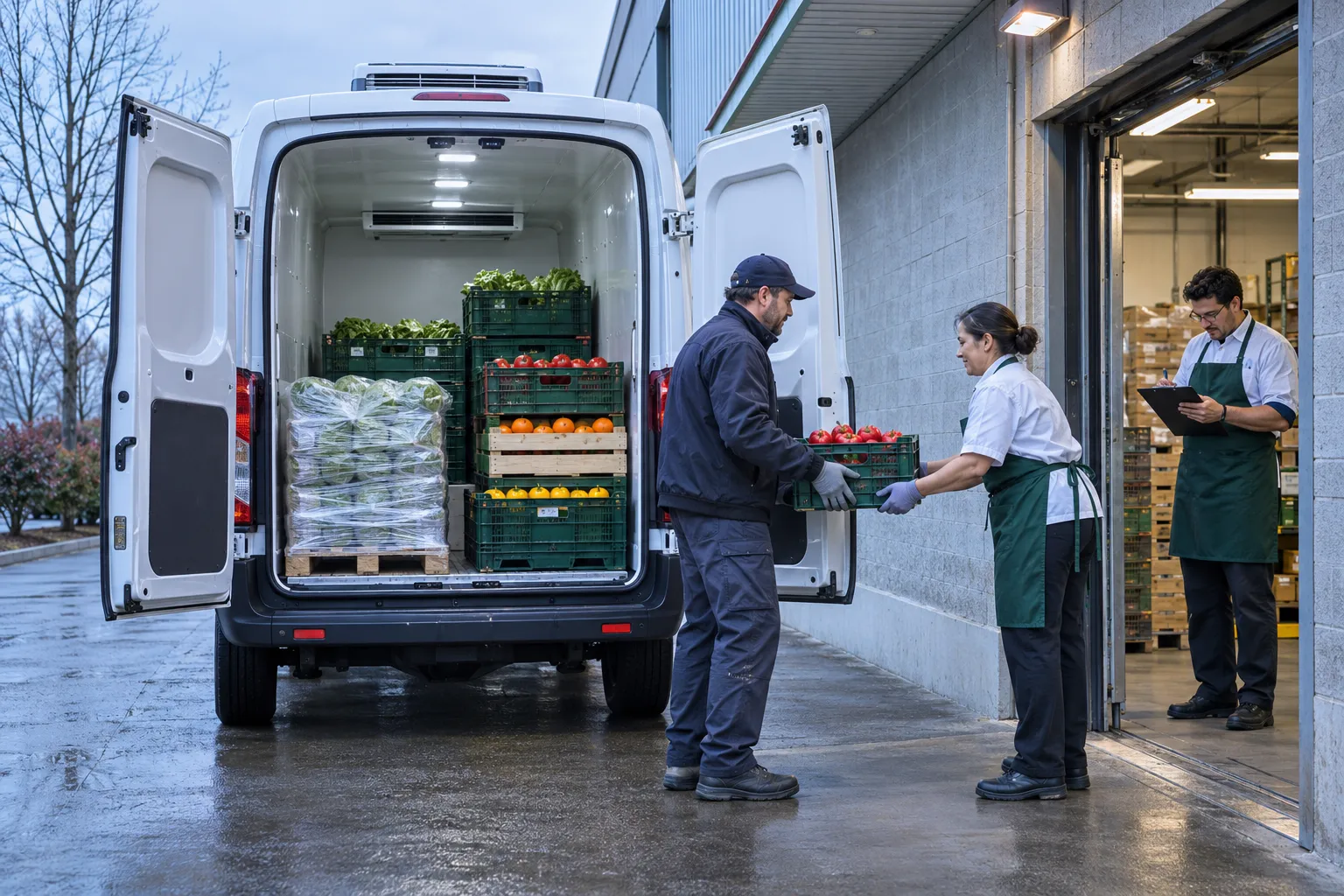
Pre-cool the product before loading
A refrigerated truck holds temperature. It is not designed to bring warm product down to it. Freight loaded above its shipping temperature can stay warm at the centre of the pallet for the whole trip, even while the air around it reads correctly.
Keep product in your cooler or freezer until the truck is at the door, and check the core temperature of a few cases with a probe thermometer before it leaves. Write the readings down. If a receiver questions the load later, those numbers show what condition it left in.
Palletise and wrap the freight
Stack cases square on sound pallets, with the heaviest at the bottom and nothing hanging over the edge. Overhang crushes cartons and takes floor space the next pallet needs. Wrap the stack to the pallet so it moves as one piece. For fresh produce and other product that gives off heat, use vented cartons and keep the wrap from sealing off the sides.
| Product | Before loading | Packing note |
|---|---|---|
| Frozen food | Hard frozen through to the core | Solid cartons; tight stacks and full wrap are fine |
| Fresh produce | Cooled to its chilled temperature | Vented cartons with gaps for air |
| Meat and seafood | Chilled or frozen through | Leak-proof packaging on clean pallets |
| Cut flowers | Cooled and kept dry | Boxes kept upright and not crushed |
| Chocolate and confectionery | Held cool and away from heat | Kept dry; avoid sudden temperature changes that cause condensation |
Label the temperature on every pallet
Put a label on at least two sides of each pallet that states the required temperature as a number, for example "Keep frozen, 0°F or below" or "Keep at 34°F". Add the receiver’s name, the pallet number such as 1 of 4, and any handling notes. Put the same temperature on the bill of lading so the label and the paperwork agree.
Leave room for airflow
Cold air leaves the refrigeration unit at the front of the box, travels along the ceiling, and returns along the floor and through the load. Pallets raise the freight so air can pass underneath. Keep the load below the air outlet and a little away from the walls and doors. Freight packed tight to the ceiling blocks the flow and leaves warm spots at the rear.
Steps for the day of pickup
Confirm the details
Check the pickup time, the setpoint and the pallet count with the carrier, and make sure the receiver expects the delivery.
Stage the pallets
Keep wrapped, labelled pallets in the cooler or freezer near the door until the truck is ready to load.
Check the truck
Ask the driver for the box temperature before loading. It should be at or near the setpoint, and the box should be clean and dry.
Load and sign
Load quickly, close the doors, and note the product temperature and the time on the bill of lading before you both sign.
Paperwork and what to tell the carrier
Most problems on a refrigerated load start with a detail nobody mentioned. Have this checklist ready when you ask for a quote and again on the day. Benefit Transportation asks for the same things, because each truck is sent for one shipper’s freight and is set up around it.
- Pickup and delivery addresses, with a contact name and phone number at each
- Pallet count, dimensions and total weight
- The required temperature as a number
- Dock, forklift or street-level access at each end
- Receiving times, and whether an appointment is needed
- Bill of lading and any documents the receiver requires
- Anything unusual: mixed products, fragile cartons, no stacking
To book a dedicated refrigerated van or box truck anywhere in the lower 48 states, call or text David at (619) 839-9809 or use the quote form.
Get a quoteRefrigerated shipping temperature guideReefer van vs box truck
Common questions
How do I prepare a refrigerated shipment?
Bring the product to its shipping temperature, stack and wrap it on sound pallets, label each pallet with the required temperature, and have the bill of lading and receiving details ready. Then tell the carrier the pallet count, weight, temperature and access at both ends.
Why does freight need to be pre-cooled before shipping?
Because a truck’s refrigeration unit is built to hold temperature and has little capacity to lower it. Product loaded warm cools slowly from the outside in, and the centre of the pallet may never reach the right temperature during the trip.
How should pallets be wrapped for a reefer truck?
Wrap them firmly enough that the stack is tied to the pallet and cannot shift. Frozen product can be wrapped fully. Produce and other product that gives off heat should be in vented cartons, with the wrap applied so air can still reach the sides.
What paperwork does a refrigerated shipment need?
At minimum a bill of lading showing the shipper, receiver, pallet count, weight, a description of the goods and the required temperature. Some receivers also ask for a purchase order number, a delivery appointment or their own forms, so check with them ahead of time.
What should I tell the carrier about my shipment?
Tell them the addresses, pallet count, dimensions, weight, the temperature as a number, the dates, and whether each end has a dock or forklift. Mention receiving times and anything unusual, such as mixed products or pallets that cannot be stacked.